Free Consultation • Available 24/7



A fall case often relies on one question: how long was the hazard there? Photos, video, and cleaning records can provide the answer.
Whether caused by a spill in a grocery store, an icy patch in a parking lot, or an uneven floor surface, these accidents frequently result in serious injuries like broken bones, spinal damage, or traumatic head trauma. The shock of an unexpected fall is often compounded by physical pain and the sudden realization that you are now dealing with medical appointments and unexpected costs.
Property owners and businesses are legally obligated to maintain safe premises for their visitors. When they fail to address known hazards, ignore maintenance requirements, or neglect to clean up dangerous conditions in a reasonable amount of time, they may be held responsible for the resulting injuries. To prove a claim, you must show that the property owner knew or reasonably should have known about the dangerous condition and did not take reasonable steps to fix it or protect visitors from it.
Berry Law investigates each slip and fall claim carefully, gathers the evidence, and handles the legal work needed to pursue compensation for your medical bills, lost wages, and pain and suffering.
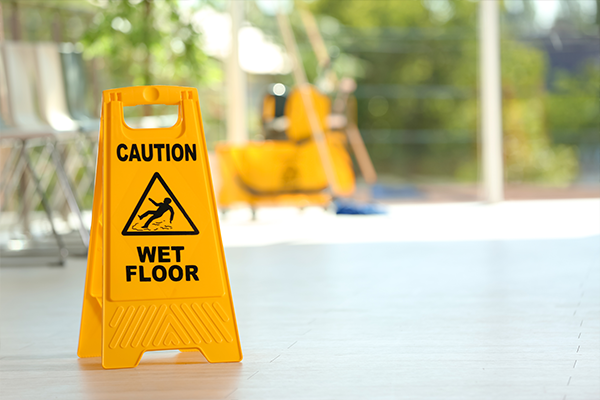
Many people believe that if a business posts a "wet floor" or "caution" sign, they are automatically shielded from any legal responsibility if someone slips and falls. This is a common misconception. In many jurisdictions, a warning sign doesn’t automatically release them from being responsible. Businesses have a consistent legal duty to maintain their premises in a reasonably safe condition. Simply placing a sign near a hazard does not necessarily fulfill this duty, especially if the hazard persists for an unreasonable amount of time, is in an unavoidable area, or if the sign itself is inadequate or poorly placed. If a business breaches this duty and an injury occurs, the injured party may still be able to recover compensation, as courts look at whether it was foreseeable that a customer would encounter the danger despite the warning.
While slip and fall claims fall under the broad umbrella of premises liability, they are distinct in nature. Premises liability is a comprehensive legal category covering various injuries that occur on another person’s property, such as swimming pool accidents, dog bites, or structure collapses. Slip and fall claims, however, are a specific subset that typically involves temporary conditions like a spill, a loose rug, or accumulated ice. These cases are often defined by the "notice" requirement, where the victim must prove the property owner knew or should have known about the specific, temporary hazard and failed to fix it. While premises liability can involve long-standing structural defects, slip and fall cases are unique because they often hinge on the timing and visibility of a temporary danger that should have been addressed by staff.
Insurance companies may attempt to shift blame to the victim by arguing that the hazard was "open and obvious" or that the customer was distracted, such as by looking at their phone or reading a product label. In many jurisdictions, courts have clarified that an obvious danger does not automatically end the owner’s duty. When assessing liability, the legal system often considers whether the owner should have anticipated that a visitor might be distracted. If a business knows customers will be occupied by shopping, reading signs, or speaking with companions, they must take extra care to ensure floors are dry and safe. Under a comparative fault system, you can often recover damages if your share of the fault is less than a certain threshold, even if you were partially distracted at the time of the incident.
A central issue in most slip and fall claims is establishing that the owner knew of the danger. This is categorized into two types: actual notice and constructive notice. Actual notice exists if employees or the owner were explicitly aware the floor was wet or dangerous, such as if a spill was reported to staff before the accident. Constructive notice is more complex and involves proving that the hazard existed for a long enough period that the owner should have discovered it through reasonable, routine inspections. If a spill was left unattended for several hours, a court may find the owner had constructive notice. At Berry Law, we will seek evidence, such as maintenance logs, surveillance footage, and company policy handbooks, to demonstrate that the business failed to identify and address the danger before it caused an injury.
Practical tools and clear information to help you understand your legal options. Explore Berry Law articles, videos, and calculators for Veterans, injured people, and their families.

Get a free review of your case from our personal injury attorneys.

A strong claim starts with the facts and follows the evidence. Berry Law handles the legal work so you can focus on your recovery.
We review your case at no cost and explain your options.
You can call us 24/7.
We gather evidence, obtain medical records, interview witnesses and build your case.
We negotiate aggressively with insurance companies to get you fair compensation.
We settle your case or take it to trial if the insurance company will not pay fairly.

Contact our personal injury attorneys today for a free consultation. We understand what you're going through and will fight for the compensation you're entitled to.


