Free Consultation • Available 24/7


Dependency and Indemnity Compensation (DIC) is a tax-free monthly benefit for eligible survivors of a deceased Veteran. See the 2027 VA DIC rates, who qualifies, and how to apply or appeal a denied claim.


Dependency and Indemnity Compensation (DIC) is a tax-free monthly benefit paid by the Department of Veterans Affairs (VA) to eligible surviving spouses, children, and parents of deceased Veterans or servicemembers. Survivors may qualify when a Veteran dies from a service-connected condition, dies during qualifying military service, or meets certain total-disability requirements before death.
This guide explains 2027 VA DIC rates, eligibility requirements, additional survivor benefits, and how to apply or appeal a denied claim. Call 888-883-2483 or request a Free Case Review.

VA DIC payments generally increase based on the annual cost-of-living adjustment (COLA). The 2027 rates take effect December 1, 2026, with the first payment at the updated rates generally arriving in January 2027. 2027 rate update: Official 2027 DIC payment amounts are listed below.
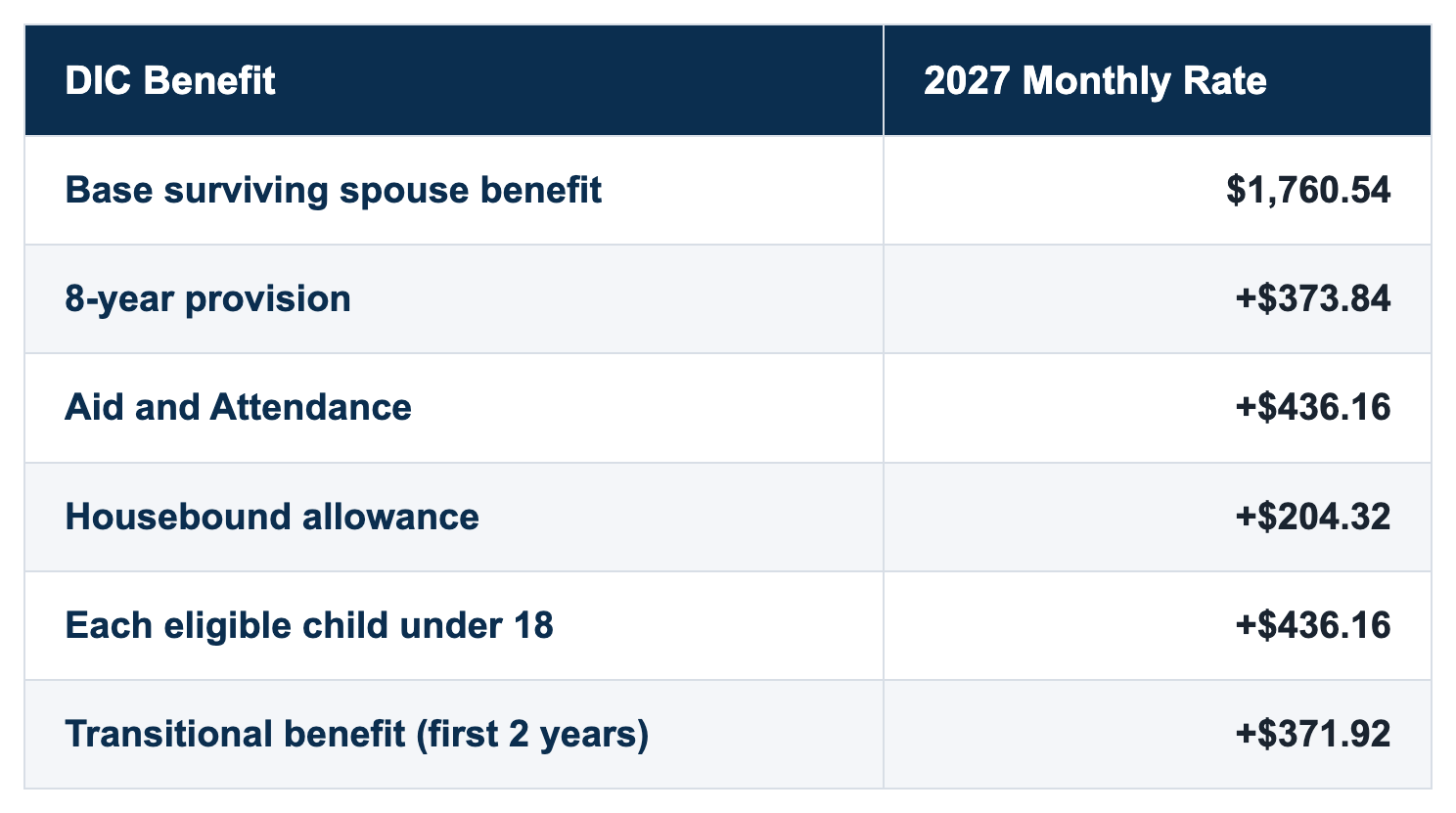
These rates generally apply to surviving spouses of Veterans who died on or after January 1, 1993. Additional amounts depend on eligibility. Different rules apply to certain earlier deaths, eligible children receiving DIC separately, and surviving parents. For official updates, visit the VA DIC compensation rates page.
Surviving spouses, dependent children, and certain parents may qualify for DIC if the servicemember or Veteran:
What Is the VA DIC 10-Year Rule?
Survivors may qualify for DIC even when the Veteran's death was not service-connected if the Veteran was continuously rated totally disabled due to service-connected conditions for:
A total disability rating based on individual unemployability (TDIU) may satisfy these requirements. Important: A Veteran does not need to have been rated 100% disabled for 10 years if the death itself was caused by a service-connected condition.
Surviving Spouses
A surviving spouse must meet VA marriage and relationship requirements. Depending on the circumstances, eligibility may be established through a qualifying marriage of at least one year, having a child with the Veteran, or other recognized marriage provisions. VA also considers continuous cohabitation, certain separations, and remarriage rules. Some surviving spouses who remarry may retain or regain DIC eligibility under specific exceptions.
Surviving Children
Unmarried dependent children may qualify if they are:
Surviving parents may also qualify for DIC, although their benefits are subject to income-based eligibility rules.
Eligible surviving spouses may receive additional monthly compensation beyond the standard DIC rate.
8-Year Provision: Additional compensation may apply if the Veteran was rated totally disabled for at least eight continuous years immediately before death and the surviving spouse was married to the Veteran throughout those same eight years.
Aid and Attendance: Additional benefits may be available when a surviving spouse needs regular assistance with daily activities, such as bathing, dressing, or eating.
Housebound Allowance: Surviving spouses who are substantially confined to their homes because of a disability may qualify for additional compensation.
Dependent Children: Additional payments may be available for eligible children under 18, including a temporary transitional benefit during the first two years after the Veteran's death.
Surviving spouses and children can generally apply using VA Form 21P-534EZ, Application for DIC, Survivors Pension, and/or Accrued Benefits.
Supporting documents may include:
Applications can be submitted through VA.gov, by mail, or with assistance from an accredited representative. Filing promptly matters. For many surviving spouse and child claims, applying within one year of the Veteran's death can preserve an earlier effective date. Different rules may apply depending on the circumstances.
Yes. If the VA denies a DIC claim, survivors may be able to request:
In most cases, requesting a review within one year of a VA decision can help preserve the earliest possible effective date.
How much will VA DIC pay in 2027?
The monthly payment depends on the official 2027 DIC rates and whether the survivor qualifies for additional benefits, such as Aid and Attendance, the eight-year provision, or dependent child allowances.
Is VA DIC taxable?
No. VA Dependency and Indemnity Compensation is a tax-free benefit.
Can a surviving spouse receive DIC if the Veteran was not rated 100% disabled?
Yes. A surviving spouse may qualify if the Veteran died from a service-connected condition, even without a 100% disability rating.
Can you receive DIC and Social Security survivor benefits?
Yes. Eligible survivors may generally receive both VA DIC and Social Security survivor benefits. Each program has separate eligibility requirements.
Can you receive DIC and military Survivor Benefit Plan (SBP) payments?
Yes. The former SBP-DIC offset was fully eliminated in 2023, allowing eligible survivors to receive full payments from both programs.
Can you receive retroactive DIC benefits?
Yes. Back pay may be available depending on the date of the Veteran's death, when the claim was filed, and applicable effective-date rules.
If your loved one passed away from a service-connected condition, or you believe the VA incorrectly denied survivor benefits, Berry Law can help you understand your options. Our team of Veterans serving Veterans helps surviving families pursue Dependency and Indemnity Compensation, challenge denied claims, and seek benefits they may have been entitled to receive.
Call 888-883-2483 or request a Free Case Review.

Our attorneys are ready to help with your case. Contact us for a free consultation.

Schedule a free consultation with our experienced attorneys. We will review your case and help you understand your options.


